PREMIERING SOON

The conceptual framework that transforms an idea into a sequence of meaning, connecting research, context, space, material, movement, and experience to create a design that unfolds as a story.

THE IDEA OF ROMANTIC
The Romantic begins with the bed.
Not because the bed represents romance in any literal sense, but because it is one of the most intimate objects in architecture. It occupies a private territory between waking and sleep, between presence and absence, between the physical world and the world of memory.
This bed is conceived as an architectural object rather than simply furniture. Its dark upholstered mass establishes a sense of enclosure, while the delicate metal canopy rises above it with an almost skeletal precision. The contrast is intentional: weight and lightness, permanence and fragility, structure and ornament.
The curved metal framework does not imitate a historical canopy. Instead, it recalls the memory of one. Its gestures suggest something familiar without becoming a quotation. The object occupies a space between recognition and invention.
This is where the Romantic becomes architectural. The Romantic is not nostalgia. It is not the reproduction of an earlier aesthetic. It is the desire to create an object that appears to possess a history even when it is entirely new.
The blackness of the bed absorbs light. The metal frame catches it. The relationship between the two creates an atmosphere in which the object becomes more than its material construction. It becomes a presence within the room.
There is restraint in this idea. Nothing is excessive. The ornament is reduced to line; the line becomes structure; the structure becomes an outline of memory. The bed therefore becomes a study in the architecture of intimacy. It suggests that the most Romantic objects are not necessarily those decorated with symbols of romance, but those capable of producing a particular psychological condition: solitude, anticipation, repose, memory, desire, and contemplation.
The object does not tell us what to feel.
It creates the conditions in which feeling can occur.
In this sense, the Romantic is not a style.
It is an atmosphere created through proportion, material, shadow, memory, and restraint.
The bed becomes architecture because it does more than occupy space.
It gives the space a reason to be remembered.
"The Romantic is not the reproduction of the past, but the preservation of its capacity to evoke memory."
Mister-LeVon Landry

THE IDEA OF GOTHIC
Gothic is often understood as a style: pointed arches, ornament, darkness, stone, tracery, towers, and the visual language of medieval architecture. But the idea of Gothic is something more complex. It is not simply an aesthetic vocabulary; it is a way of constructing meaning through atmosphere, proportion, memory, ritual, tension, and the experience of moving through space. This distinction forms the foundation of our understanding of narrative versus theme.
A theme gives a project its recognizable language. Gothic may provide the vocabulary: darkness, verticality, ornament, repetition, shadow, materiality, and monumentality. But these elements alone do not constitute a Gothic narrative. They are references. They become meaningful only when they are placed into a sequence of relationships that produces an experience.
The Gothic cathedral, for example, is not defined by the pointed arch alone. The arch is only one element within a larger narrative of ascent, procession, light, scale, mystery, and transcendence. The verticality of the architecture directs the eye upward. The filtered light alters perception. Repetition establishes rhythm. Ornament carries symbolic meaning. The movement from threshold to nave to sanctuary creates a sequence of discovery. Architecture becomes a vehicle through which an idea is experienced rather than simply represented.
This is the distinction between theme and narrative. A theme asks what something is about. A narrative asks what happens when we encounter it. A theme can describe the appearance of a space; a narrative establishes its progression, its tension, its emotional condition, and ultimately its meaning.
In this sense, the black four-poster bed becomes more than a Gothic reference. Its darkness, exaggerated verticality, carved posts, repetition, nailhead detailing, and monumental proportion establish a thematic vocabulary. The narrative emerges through their relationship. The bed becomes an architectural object; the posts become a kind of vertical procession; the enclosure suggests intimacy and ritual; the blackness introduces weight and presence; the symmetry establishes order. What initially appears to be a collection of stylistic references becomes a deliberate spatial proposition.
The Gothic, therefore, is not something we reproduce. It is something we interpret. We look beyond its familiar forms toward the principles beneath them: the power of verticality, the drama of light and shadow, the significance of threshold, the relationship between ornament and meaning, and the ability of architecture to make an invisible idea physically present.
A theme tells us what to see. A narrative determines how we experience what we see.
Concept establishes the idea. Theme establishes its vocabulary. Narrative establishes its journey. Architecture gives the journey form.
The objective is not to design something that looks Gothic. It is to understand the idea of Gothic deeply enough that its principles can become something entirely new.
"Better the rudest work that tells a story or records a fact, than the richest without meaning."
John Ruskin
The Seven Lambs of Architecture
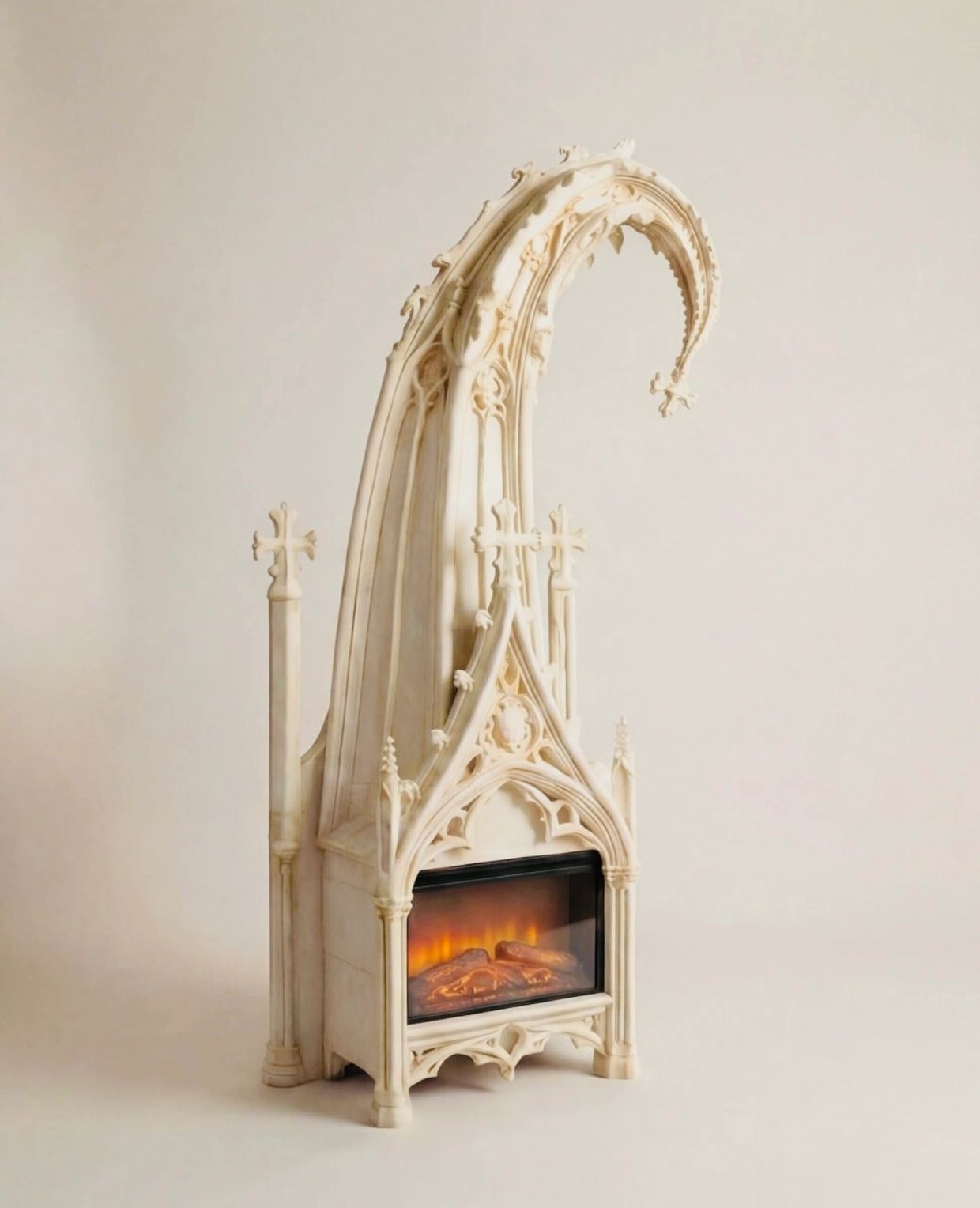
THE IDEA OF GOTHIC REVIVAL
Gothic Revival is more than the reappearance of a historical architectural language. It is an inquiry into the enduring power of architectural memory: the ability of form, ornament, material, and symbolic reference to carry meaning across time.
The Gothic tradition is recognized through its pointed arches, vertical emphasis, intricate tracery, slender pinnacles, and sculptural ornament. Yet its significance extends beyond these recognizable elements. Gothic architecture established a relationship between structure and symbolism, where the organization of space, the articulation of material, and the movement of the eye could contribute to an experience of reverence, contemplation, and transcendence.
The Gothic Revival reinterprets this inheritance. Rather than treating historical architecture as a vocabulary to be reproduced, it offers an opportunity to reconsider what its forms might mean within a contemporary context.
The fireplace presented in these studies explores that possibility. An object traditionally associated with domestic comfort becomes an architectural composition with the presence of a miniature monument. Its elongated profile, ascending ribs, clustered pinnacles, and elaborate pointed arch recall the spatial language of the Gothic cathedral. The ivory-toned surface emphasizes the sculptural quality of the ornament, while the contemporary firebox introduces a functional element that belongs unmistakably to the present.
The relationship between these elements is central to the concept. The historical reference establishes a sense of permanence and ceremony; the modern intervention introduces a different understanding of use. Neither is required to disappear into the other. Instead, their coexistence creates a dialogue between inherited form and contemporary life.
The most compelling aspect of this approach is the transformation of the familiar. A fireplace becomes an architectural threshold, an ornamental object becomes a study in verticality, and a domestic function acquires a symbolic dimension. The design invites us to consider whether historical forms can retain their expressive power without being confined to historical buildings.
For the student of architecture, this distinction is essential. Gothic Revival should not be understood simply as the application of pointed arches, carved ornament, or medieval references. Its deeper potential lies in the examination of why these forms emerged, what they communicated, and how their underlying principles might be reconsidered today.
Can ornament contribute to meaning rather than merely decorate a surface? Can a contemporary object evoke the gravity of a sacred structure? Can historical reference produce something intellectually and formally new?
These are the questions through which revival becomes an act of design rather than imitation.
THE IDEA OF GOTHIC REVIVAL proposes that architectural history remains an active field of inquiry. Its forms are not fixed conclusions but sources of continuing interpretation. Through careful observation, critical understanding, and deliberate transformation, the past can become material for new architectural thought.
The objective is not to recreate what once existed, but to discover what it might mean now.
Clarify the Fireplace Study EarlierDefine Revival as a Method
“The principle of the Gothic architecture is infinity made imaginable.”
Samuel Taylor Coleridge